
Tokenization moves from issuance to utility.
The market is moving past the issuance milestone and toward collateral, custody, compliance and settlement.
- Published
- August 24, 2026
- Publisher
- Sergio de Varona
- Format
- Original analysis + visual intelligence
- Disclosure
- Educational editorial content
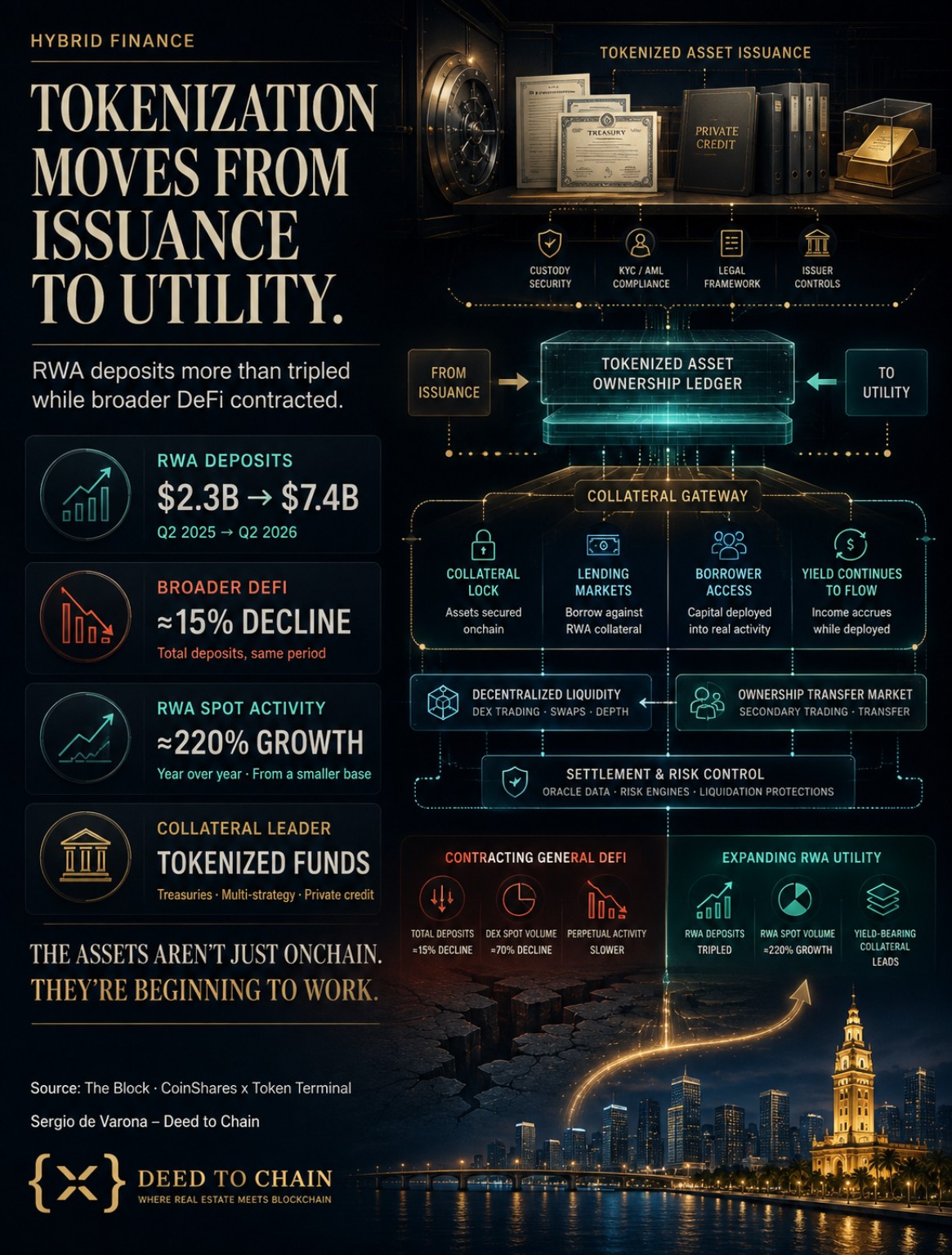
Tokenization’s first chapter was about proof: a bond, fund, share or receivable could be represented on a programmable ledger. The next chapter is harder. The asset has to work inside the institutional system that already governs money, risk and ownership.
Issuance is not the same as utility.
A token can exist and still remain economically inert. Utility arrives when the asset can move through lending, collateral management, treasury operations, secondary transfer and settlement while maintaining the protections expected in regulated markets.
RWA.xyz reported $27.65 billion in distributed real-world assets as of April 2, 2026, excluding represented assets and stablecoins. That scale is meaningful, but the more important shift is qualitative: institutions are increasingly testing tokenized funds, private credit, government securities and collateral workflows rather than treating tokenization as a branding exercise.
The institutional market will judge tokenization by what assets can do—not by how many tokens can be issued.
The physical and legal asset still matters.
Putting a record onchain does not automatically transfer legal title, erase jurisdictional requirements or replace attorneys, custodians, registrars, lenders and regulators. The strongest structures connect the digital record to enforceable rights, reliable identity, sound governance and a defensible process for correction and dispute.
That distinction matters especially in real estate, where title, recording, entity structure, securities law, tax and local jurisdiction all remain part of the transaction. The digital rail may become more efficient. It does not make the physical asset disappear.
Sources and further reading
The Deed to Chain lens
What changes for property, capital, ownership and Miami when the underlying infrastructure moves?
- tokenization
- RWA
- settlement
- digital assets
Related intelligence

Capital has started to choose its rails.
Institutional tokenization is being measured less by announcements and more by assets, flows and usable infrastructure.
Open briefing →
The tap is instant. The money is not.
What consumers experience as a moment still rests on messaging, liquidity, compliance and settlement infrastructure.
Open briefing →
Policy is becoming market infrastructure.
Digital-asset regulation now defines who can build, custody, clear, distribute and scale.
Open briefing →