
Policy is becoming market infrastructure.
Digital-asset regulation now defines who can build, custody, clear, distribute and scale.
- Published
- August 20, 2026
- Publisher
- Sergio de Varona
- Format
- Original analysis + visual intelligence
- Disclosure
- Educational editorial content

Digital-asset policy is often discussed as a political argument around innovation or enforcement. For the market, it is more concrete: policy determines the operating architecture.
The CLARITY process is a market-design process.
H.R. 3633 passed the House in July 2025 and advanced from the Senate Banking Committee in May 2026. The Senate’s published schedule indicates that a cloture motion on the bill is set to ripen on September 15, 2026. The final outcome remains uncertain, but the direction of the debate is already affecting how firms plan custody, trading, disclosure and compliance.
For institutional participants, the practical issue is not whether digital assets should be “allowed.” It is whether the rules create a coherent chain of responsibility from issuance through secondary markets, customer protection and bankruptcy treatment.
Market structure is not background law. It is part of the product.
Real estate will inherit the consequences.
Tokenized property interests, real-world-asset funds and digital settlement models all depend on clear treatment of securities, commodities, intermediaries and customer assets. A technology layer can be elegant and still fail if the legal rights beneath it are ambiguous.
The most durable real-estate applications will be built by teams that understand title, securities, custody, compliance and local execution—not by treating a token as a substitute for those systems.
Sources and further reading
The Deed to Chain lens
What changes for property, capital, ownership and Miami when the underlying infrastructure moves?
- policy
- CLARITY Act
- market structure
- regulation
Related intelligence
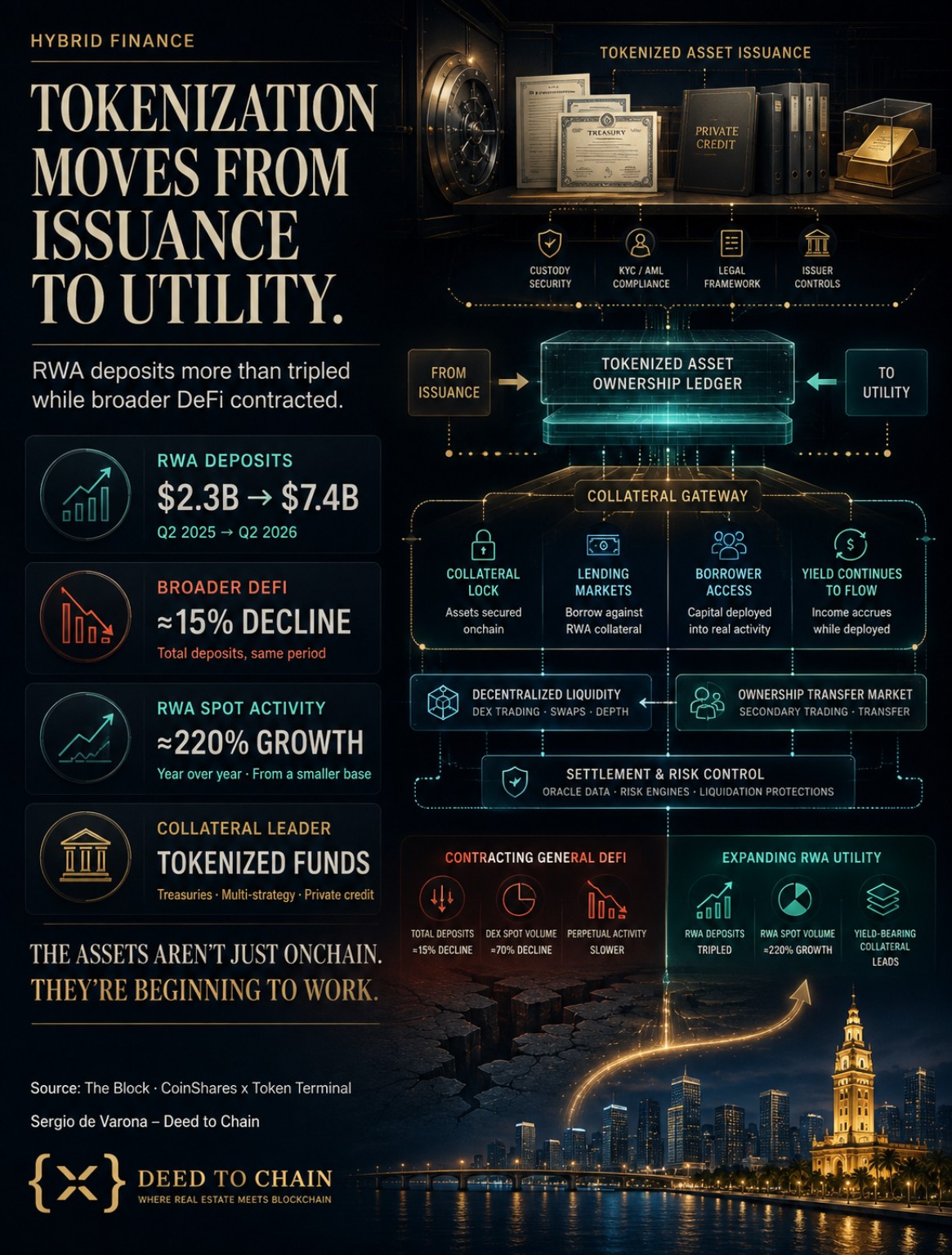
Tokenization moves from issuance to utility.
The market is moving past the issuance milestone and toward collateral, custody, compliance and settlement.
Open briefing →
The tap is instant. The money is not.
What consumers experience as a moment still rests on messaging, liquidity, compliance and settlement infrastructure.
Open briefing →
Capital has started to choose its rails.
Institutional tokenization is being measured less by announcements and more by assets, flows and usable infrastructure.
Open briefing →