
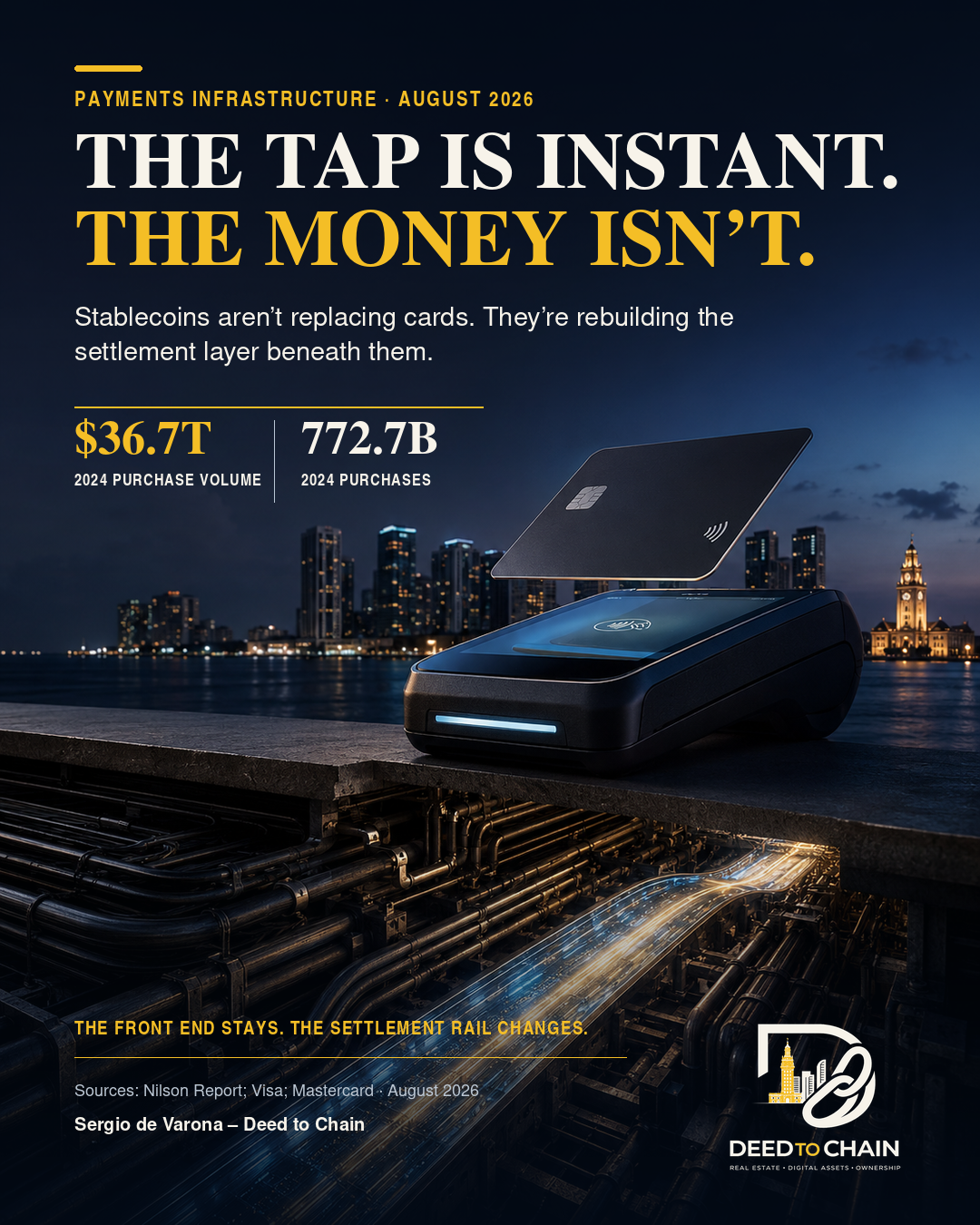
The modern payment experience is designed to feel immediate. A card taps, a confirmation appears and the customer moves on. Underneath that moment sits a chain of authorization, messaging, fraud controls, funding, clearing, reconciliation and final settlement.
The hidden layer
- Fast user experience does not always mean final settlement.
- Liquidity and compliance remain operational constraints.
- Tokenized money and shared ledgers may compress steps, but governance still decides trust.
Scale makes the infrastructure visible.
Visa reported $14.2 trillion in fiscal 2025 payment volume and 257.5 billion transactions processed on its networks. At that scale, small improvements in speed, fraud detection, liquidity visibility or reconciliation can become material across the system.
BIS experiments such as Project Rialto examine how instant payment systems, automated foreign-exchange conversion and central-bank-money settlement might simplify cross-border transactions. The central question is not whether the front end can move faster. It is whether the underlying obligations can settle with less risk and less friction.
The next payments competition will be fought beneath the interface.
Why this matters to property.
Real estate is a slow, high-value transaction built around identity, escrow, title, lender conditions, compliance and recorded ownership. New payment and settlement rails will matter only if they integrate with those obligations. Speed without legal certainty is not progress.
The long-term opportunity is a coordinated transaction in which funds, approvals, records and transfer conditions become more interoperable. That is a different proposition from simply accepting a digital asset at closing.